
 Download App
What is a mastermind group
A mastermind group is a peer advisory group. Members are at a similar stage, often in similar businesses or roles, and they meet regularly to share problems, give honest feedback and hold each other to commitments.
It differs from a course or a coaching program in one way that matters: the value comes from the members, not from a single expert. A facilitator keeps time and order, but the advice flows sideways.
Peer-led
Members take turns as facilitator. Works well for experienced founders who know each other. Cheap to run, harder to keep disciplined.
Facilitated
A paid host selects members, runs the sessions and enforces the rules. Most paid masterminds work this way.
Group coaching hybrid
A coach teaches a short topic, then the group works on member cases. Common in coaching businesses that sell a cohort.
How big should a mastermind group be
Small enough that every member gets real time, big enough that one absence doesn't kill the session. For most groups that means 5 to 8 people.
| Size | What it feels like | Watch out for |
|---|---|---|
| 3 to 4 | Very deep, everyone talks every time | One person missing changes everything |
| 5 to 8 | Each member gets a hot seat every 1 to 2 months, plus input every call | Needs a firm timekeeper |
| 9 to 12 | More perspectives, more energy | Quiet members disappear; split into pods |
| 12+ | A community with mastermind pods inside it | Needs a host per pod and a shared archive |
Pick members by stage, not by friendship. A member whose problems are 3 years ahead or behind the rest will either get bored or get lost.
How to find and select members
The best mastermind groups are curated. A short application and a 15-minute call with each candidate save you months of a group that doesn't gel.
1. What do you do, and what stage is your business or role at?
2. What is the one problem you most want help with in the next 6 months?
3. What can you offer other members (experience, contacts, skills)?
4. Can you commit to [day, time], every [week / 2 weeks], for [6 / 12] months?
5. Are you comfortable with sessions being recorded and kept private to the group?
6. Who referred you, if anyone?
Look for 3 things in the answers: a real problem, something to give back, and a yes to the schedule without hedging. Commit to a fixed term, such as 6 or 12 months, so members can leave cleanly and new ones can join at a clear point.
Mastermind group rules that hold up
Agree on the rules before the first session and write them down where every member can find them. Rules nobody can find are rules nobody keeps.
- Confidentiality. What is said in the group stays in the group. This includes recordings and summaries: they're for members only.
- Attendance. Show up, on time, camera on. Set a number: more than 2 missed sessions a quarter means a conversation about whether this is the right time to be in the group.
- Preparation. The hot seat member sends their question and context 48 hours before the call.
- Honest feedback. Say what you think, kindly. "Have you considered" is better than silence.
- Commitments. Every member leaves with one action and reports on it next time.
- No selling. Members don't pitch each other unless someone asks.
How to run a mastermind group session
Most groups meet every week or every 2 weeks for 60 to 90 minutes. The structure below fits a 90-minute call with 6 members and one or two hot seats.
Wins and check-in (10 min)
Each member shares one win and one number from the past week. Keep it to 60 to 90 seconds each.
Commitment review (10 min)
Members report on last session's action: done, not done, what got in the way.
Hot seat 1 (30 min)
The member presents the problem in 5 minutes. The group asks clarifying questions only. Then feedback and ideas. The member listens and takes notes, then responds at the end.
Hot seat 2 or a topic (25 min)
A second hot seat, or a short shared topic: a member teaches something they figured out, or the host brings a guest.
Commitments (10 min)
Each member states one action for next time. The host writes them down where everyone can see them.
Close (5 min)
Date of the next call and who is in the hot seat. Stop on time.
The hot seat member talks least during their own hot seat. Their job is to listen.
What happens to the knowledge after each session
Here is where many masterminds leak value. A great hot seat produces 20 minutes of advice from 5 smart people. A week later, the member remembers 3 points. A year later, nobody can find it, even though another member now has the exact same problem.
The fix is a short pipeline that runs after every call:
Recording
Record every session (with consent, as agreed in the rules). Upload it to YouTube as unlisted or to Vimeo.
Transcript
Get a full text of what was said. This is what makes the session searchable later.
Summary
A short summary: the problem, the main ideas, the decision, the commitments. Members skim it in 2 minutes instead of rewatching 90.
Searchable archive
All sessions in one private library, searchable across every call. "Pricing a retainer" finds the hot seat from March even if nobody called it that.
Sessions without an archive
- Recordings sent as links in the group chat
- Notes in each member's own notebook
- New members miss everything before they joined
- The same problem gets solved twice
Sessions with an archive
- Every call on one page: video, transcript, summary
- Commitments written down and visible next time
- New members catch up on the best hot seats
- Search finds past advice by meaning
Running a mastermind group in Telegram with Embedify
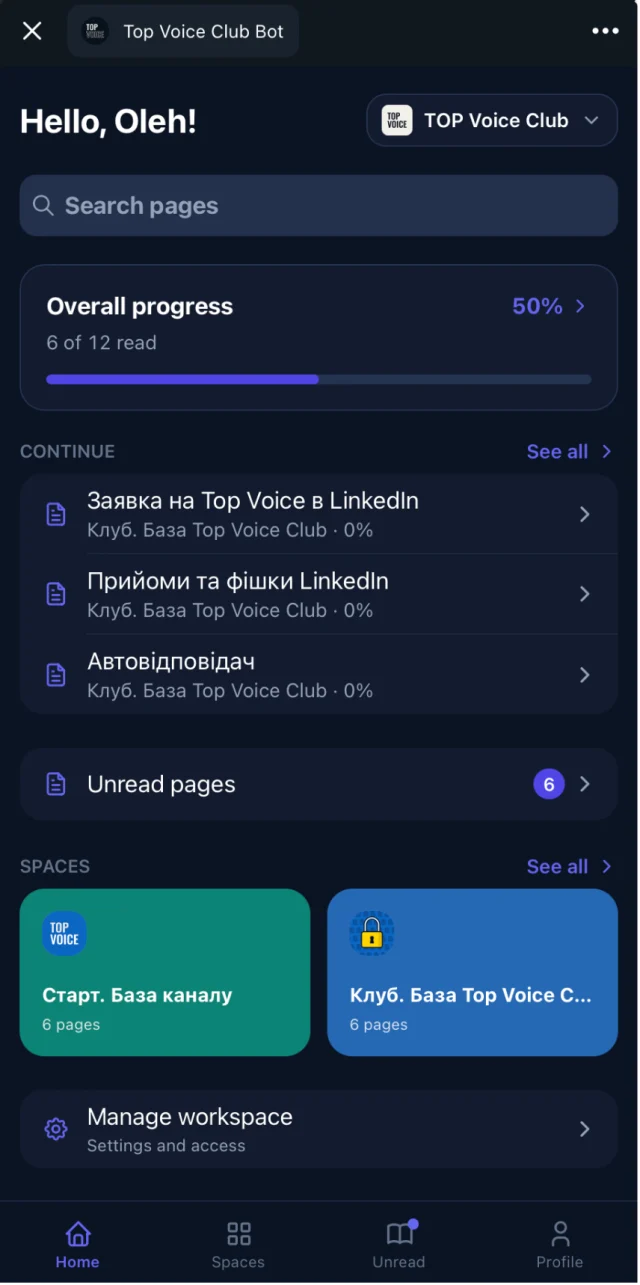
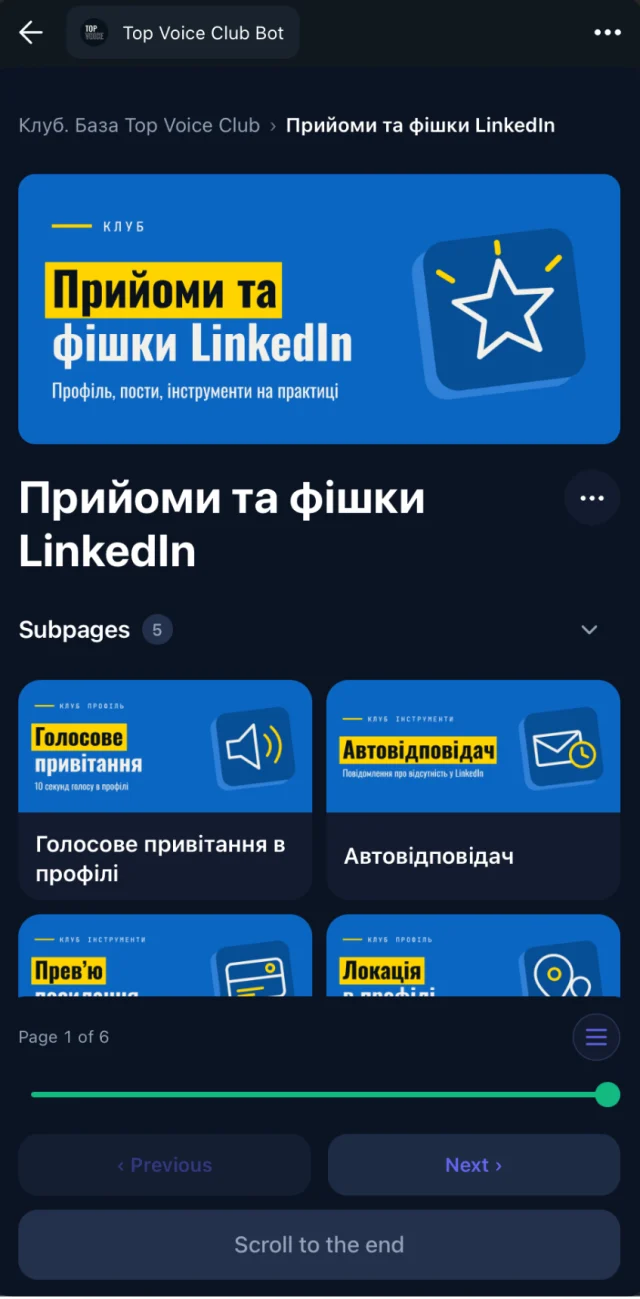
Many groups already coordinate in a Telegram chat. Embedify adds the archive to that chat. The library opens inside Telegram as a Mini App, so members don't switch apps to find last month's session.
- Video with transcript and AI summary. Add a YouTube or Vimeo recording to a page and members get the transcript and a summary next to the video.
- Search across every session. Full-text plus semantic search covers pages, decks and transcripts.
- Access follows the group. Members of your Telegram group get access automatically. When someone leaves the mastermind, their access goes with them.
- Separate spaces. If you run several groups or pods, access groups keep each pod's sessions private to that pod.
- Reading progress. You see who opened and who finished a session page, useful before a member's hot seat.
You can start on the Free plan. Private access and your own branded bot start on Basic from $29/month; meeting summaries are part of Pro, see pricing. For a ready setup, see Embedify for masterminds and coaching groups.